Indicators

Measuring What You Can’t See

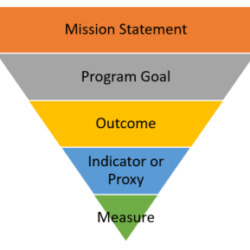
In my last post, I argued that you can’t measure what you haven’t defined. Too many nonprofits try to measure broad or vague outcome statements, which results in confusing surveys and largely useless data. Identifying clear, specific indicators makes measurement easier and more meaningful. Indicators are the critical middle step between outcomes and measurement tools.[…]


Indicators Guide Measurement

You Cannot Measure What You Have Not Defined!

That might not sound like an earth-shattering proclamation, and I don’t know if I’m the first or only one to say it. But I’m going to make that my primary call to action for nonprofits! Nonprofits know we are (supposed to be) making a difference in people’s lives, and we know we are supposed to[…]

Subtraction by Addition

For years, I’ve had an image in my head that represented the results of nonprofits’ often piecemeal, reactive efforts to respond to stakeholder demands and ill-fitting funding opportunities. It can be a patched together, mismatched, less-than-functional mishmash of unclear intentions and unfocused efforts. In my research, I came across a term in home remodeling: subtraction[…]

Top 10 Tips for Outcome Statements

As a consultant and grant-maker, I’ve read a lot of outcome statements – the good, the bad, and the ugly. From that experience, I’ve identified my top 10 tips for writing strong outcome statements. Overall, if nothing else, make sure your outcomes are meaningful, measurable, and manageable. This requires that they be specific. Read on[…]

Culture of Learning

Cultures of Learning

In my last post, I offered a basic definition of organizational culture: the system of shared beliefs, values, and assumptions that govern the way people behave in organizations. Culture shapes how we communicate, make decisions, reward and incentivize certain behaviors, solve problems, make change, set direction, and on and on. Culture can Kill Change In[…]

Culture beneath the surface

What Is Organizational Culture?

Peter Drucker, the ultimate management guru, famously said, “Culture eats strategy for breakfast.” Most nonprofits will invest hundreds of hours if not tens of thousands of dollars to create strategic plans, while few approach their culture with the same level of intention.   Consultants like me love to design and build things – plans, processes,[…]

Outputs vs outcomes

Measuring Outcomes that Matter

In my last post, I argued that one of the main reasons that front-line staff (case managers, therapists, youth workers, nurses, mentors, volunteers) in nonprofits might not get invested in collecting and using data is because it’s the wrong data. Too often, nonprofits settle for counting what’s easy to count rather than measuring what matters[…]

3 Reasons Why Your Staff Might Not Care About Your Data

In all my teaching, training, and consulting, I’ve seen a continuum of attitudes about data, evaluation, learning, performance management and the like. Like any continuum, there are extremes at either end. There are those who love and value it (like me, and maybe you?) and those who dread or resent it. Here’s some of what[…]

Leadership Support

What it Takes to Improve

A few months ago, I was inspired by an article I read from Inc. magazine, entitled “The One Position Not Many Companies Have, But Need” by Tom Gimbel. He asserts that leaders of growing companies – and, I would argue, nonprofits – lose touch with the ins-and-outs of daily operations and how the organization functions.[…]

Transformative Change CQI

6 Ways Quality Improvement can Transform Your Organization

In my last post, I argued that for continuous quality improvement work in nonprofits to be meaningful and make significant impacts on an organization, it must be: Intrinsically motivated Guided by our own definitions of quality Directed toward goals and driven to change Integrated, not siloed Applied and iterated In this post, I want to[…]