
Using the Science of Measurement to Enhance the Art of Clinical Work (Part 2)

This is the second post from our guest blogger, Julia Pickup, who is lending her unique perspective on outcome measurement, evaluation, and cultures of learning and improvement. Julia is a skilled family therapist and leader of clinicians. This set of posts is named after a common point of resistance I meet when talking with direct[…]


Using the Science of Measurement to Enhance the Art of Clinical Work (Part 1)

As promised in our October newsletter (click here to subscribe), Insight Partners has some exciting things planned for our third year, including this blog series by guest blogger Julia Pickup, MSW, LCSW. Julia is a highly skilled therapist, clinical supervisor, instructor, and program director. She thrives on developing clinicians to reach their full potential, building team[…]

Top 5 Challenges Nonprofits Face in Outcomes Measurement

There’s one thing I love most about the internet – the ability to enter a phrase into a search box that describes a problem that you think is nameless, ill-defined, and without a clear solution and then discover through pages of search results that: (1) it has a name, (2) you aren’t the only one[…]

Bringing Data to Life: Facilitating Engaging Discussions

I’ve been to countless team, committee, and Board meetings where entire packets and slide decks of lists, tables, and graphs of data are presented only to be glanced at and set aside. Rarely do we visualize and present data in a way that suggests we could and should reflect on or engage with it. What[…]

Driving Board & Committee Work with Data

Management and quality guru W. Edwards Deming said, “Without data, you’re just another person with an opinion.” Does that sound like one of your committee meetings? Lots of opinions? Do your committees glance at reports you spent hours preparing and then say things like, “And?” or “So?” or “Yeah, but . . .” Do your[…]

Data and Strategy and Boards – Oh My!

We are back after taking a hiatus in July to focus on wrapping up and ramping up several projects. We are excited to dig into this series of posts about data, strategy, and nonprofit governance. Over the past few months, several of our clients have faced challenges when it comes to engaging their Boards and[…]

Making Sense of Overwhelming “Plans”

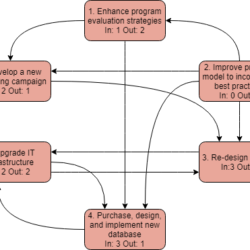
Has your organization recently completed a strategic planning process and created a “plan” that is nothing more than a glorified (and long) laundry list? Do you create annual plans full of aspirational goals that never quite get fully operationalized or implemented because no one knows where to start? Did you get a list of feedback[…]

Manageable Process

Using Theory of Change to Articulate Your Impact When You’re One Piece in a Puzzle

Many of us do work that is inherently and inarguably valuable. There is an intuitive and logical connection between the work we do and some larger, later good. Yet our actual, direct impact is hard to define or know. For years, these programs have been funded based on their face value, but many funders now[…]

Evaluative Thinking in Program Design, Management, and Evaluation

This is the fourth and final post in a series on Evaluative Thinking (ET) in nonprofits. In the first post, I shared definitions of ET and contrasted it with evaluation itself. Next, I shared some tips and tools for encouraging and practicing ET. And last time, I shared some examples of what ET looks like[…]

evaluative thinking

Evaluative Thinking Isn’t Just for Program Evaluation

Often, people in the nonprofit world hear the “e” word (whispers: evaluation) and they think of program evaluation, outcomes, and impact. However, evaluative thinking is a way of leading, planning, and making decisions that can be applied to all of an organization’s operations. Recall that the various definitions of evaluative thinking emphasize that it: Is[…]